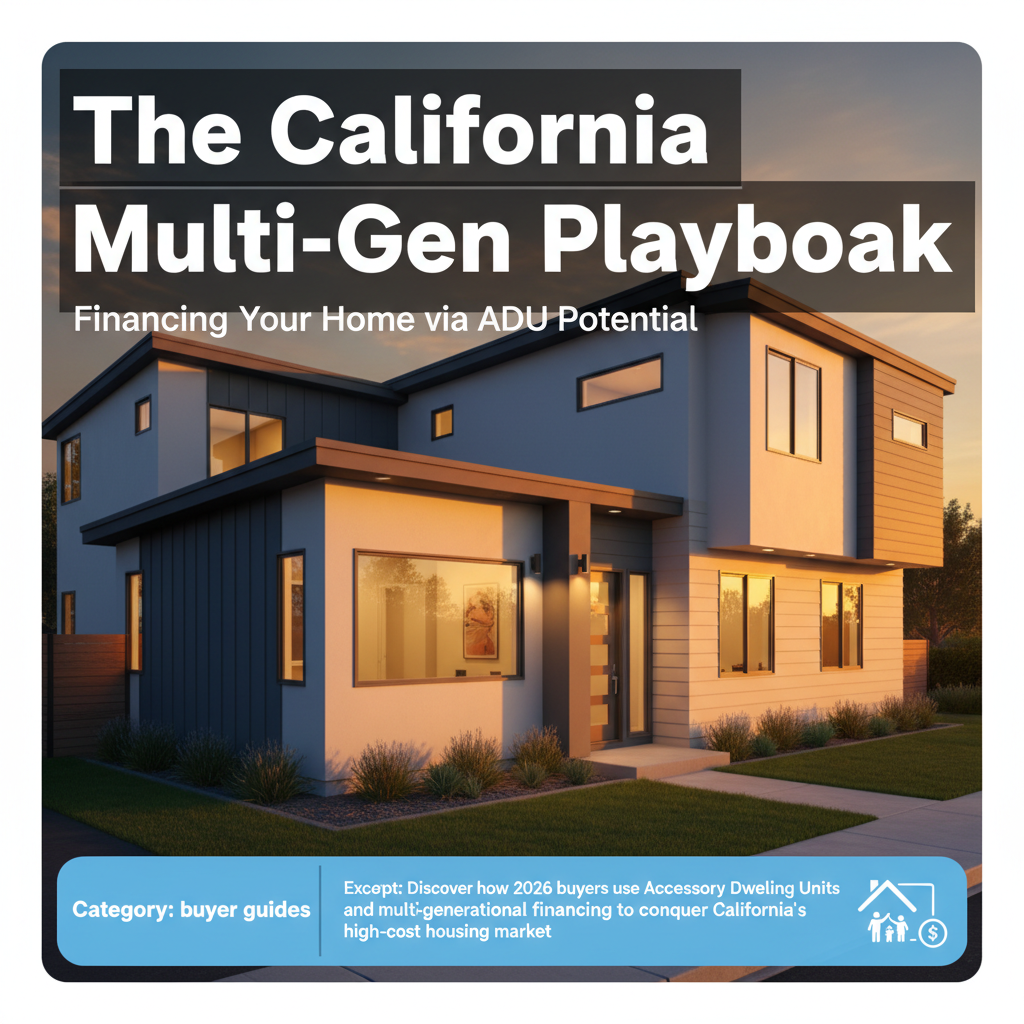
Navigating the 2026 California Affordability Gap
As of May 2026, the California real estate market continues to challenge traditional single-family homeownership models. With the statewide median home price hovering near $915,000 according to recent California Association of Realtors (CAR) data, the 'standard' entry point has shifted. Practical buyers are no longer just looking for a three-bedroom ranch; they are seeking 'income-ready' or 'multi-gen' properties that leverage California’s aggressive housing laws to offset mortgage costs.
The Multi-Generational Financing Advantage
Current National Association of Realtors (NAR) data indicates that 15% of buyers in high-cost states are now purchasing multi-generational homes. In California, this is often a financial necessity rather than just a lifestyle choice. Buyers are increasingly utilizing FHA non-occupant co-borrower loans, allowing parents or relatives to contribute their income toward the debt-to-income (DTI) ratio without residing in the property. This strategy, combined with California’s unique property tax environment, allows for a higher purchase ceiling in competitive coastal and tech-hub markets.
Identifying 'ADU-Ready' Properties
The California Department of Housing and Community Development (HCD) reported a 22% year-over-year increase in Accessory Dwelling Unit (ADU) completions in 2025. For a 2026 buyer, the goal is to identify a property that isn't just a home, but a footprint for expansion. When touring homes, prioritize the following markers:
- Lot Setbacks and Easements: Look for 'clear-to-build' zones in rear yards that meet the statewide minimum 4-foot side and rear setbacks.
- Utility Capacity: Verify if the electrical panel is 200-amp ready, as upgrading for an ADU can cost between $3,500 and $7,000 post-closing.
- Garage Conversion Feasibility: Under SB 9 and current ADU mandates, converting a garage is the fastest path to a rental unit, often bypassing many local discretionary reviews.
Maximizing the SB 9 and SB 10 Framework
While previous years focused on the passage of these laws, 2026 is about their practical implementation. Buyers should look for properties zoned for single-family residential (R1) that meet the lot-split criteria (minimum 1,200 sq. ft. per newly created lot). A savvy investor-buyer in 2026 can essentially 'house-hack' by splitting a lot or converting a single-family home into a duplex, a move that can increase the property's appraised value by 15-25% in high-density areas like San Diego or San Jose.
Practical Takeaways for the 2026 Buyer
To succeed in the current market, transition from a consumer mindset to a developer mindset:
- Check the 'Pre-Approved' ADU Plans: Many California cities (like Sacramento and Los Angeles) now offer pre-approved, permit-ready ADU plans that can save you $10,000 in architectural fees.
- Investigate CalHFA ADU Grants: Check for remaining allocations in state-sponsored grant programs which provide up to $40,000 for pre-development costs.
- Analyze 'Income Substitution': When calculating your monthly payment, work with a lender who understands how to factor 75% of potential ADU rental income into your qualifying loan amount—a standard practice for savvy 2026 buyers.
By focusing on properties with the structural and legal capacity for densification, California buyers can bypass the affordability squeeze and build equity in a market that remains one of the world's most resilient real estate environments.