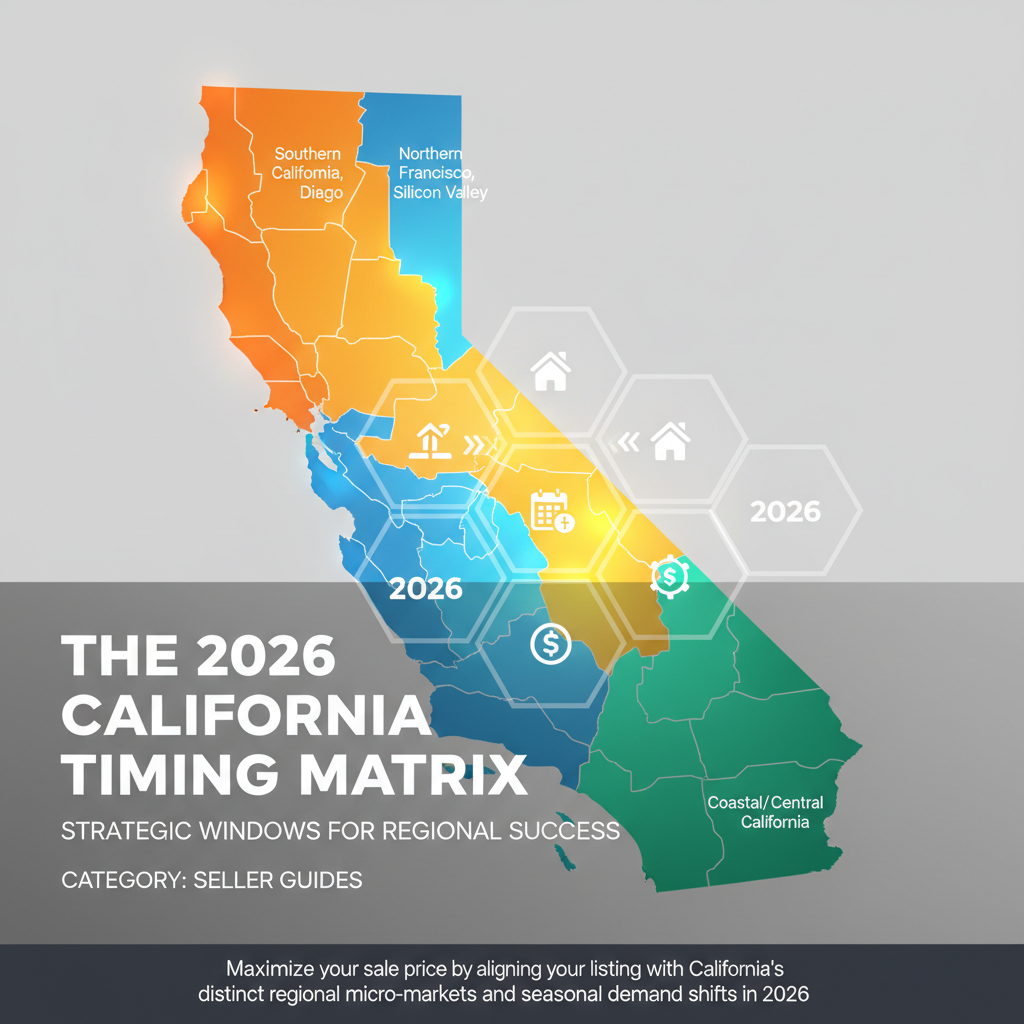
Navigating the California Micro-Market Divergence
In 2026, California's real estate market has fragmented into distinct regional performance zones. While the national trend focuses on interest rate stabilization, California sellers must look closer to home. According to recent MLS data, the price-per-square-foot variance between the Central Valley and Coastal Orange County has widened by 12% over the last eighteen months, requiring a surgical approach to listing timing and regional positioning.
The Coastal Window: Leveraging the Post-Gloom Premium
For sellers in markets like Santa Monica, Santa Barbara, or the Monterey Peninsula, the traditional Spring rush often hits a snag known as May Gray or June Gloom. 2025 data indicated that coastal properties listed in late July and August—after the marine layer clears—received 14% more foot traffic and 5% higher opening bids than those listed in May. Buyers in these high-value zones are purchasing a lifestyle; visibility and natural light are quantifiable assets that peak in late summer.
Inland and Desert Strategies: Beating the Heat and the Competition
Conversely, the Inland Empire and Greater Palm Springs markets require an inverted calendar. As temperatures in the Coachella Valley often exceed 110 degrees by July, the Sweet Spot has shifted to the February-April window. Properties in Riverside and San Bernardino counties that hit the market before the summer heat spike currently spend an average of 18 fewer days on market (DOM) than those listed in the summer doldrums. In 2026, the cost of cooling a vacant home for showings has become a significant seller expense, making a fast spring sale even more vital for the bottom line.
The 14-Day Velocity Rule
In the current 2026 landscape, the new listing luster fades faster than ever. Data from the California Association of Realtors suggests that if a property does not receive an offer within the first 14 days, the eventual sale price drops by an average of 3.1%. This necessitates an aggressive Pre-Marketing phase. Sellers should deploy high-resolution digital assets and localized social media targeting two weeks before the official MLS entry to ensure that Day 1 on the market is met with maximum urgency.
Practical Takeaways for 2026 Sellers
- Climate-Sync Your Listing: If you are in an inland valley, list before May 15th to avoid the Heat Slump. Coastal sellers should target the clear skies of late summer for maximum curb appeal.
- Monitor Local Inventory Thresholds: In 2026, Micro-Inventory is king. Avoid listing if your specific neighborhood has more than three active comparable listings within a half-mile radius; wait for one to move into escrow to reduce buyer choice.
- Prioritize Visual Logistics: Use drone photography to highlight proximity to regional amenities like parks or transit hubs to appeal to the 2026 hybrid worker demographic who prioritizes local connectivity over office proximity.


