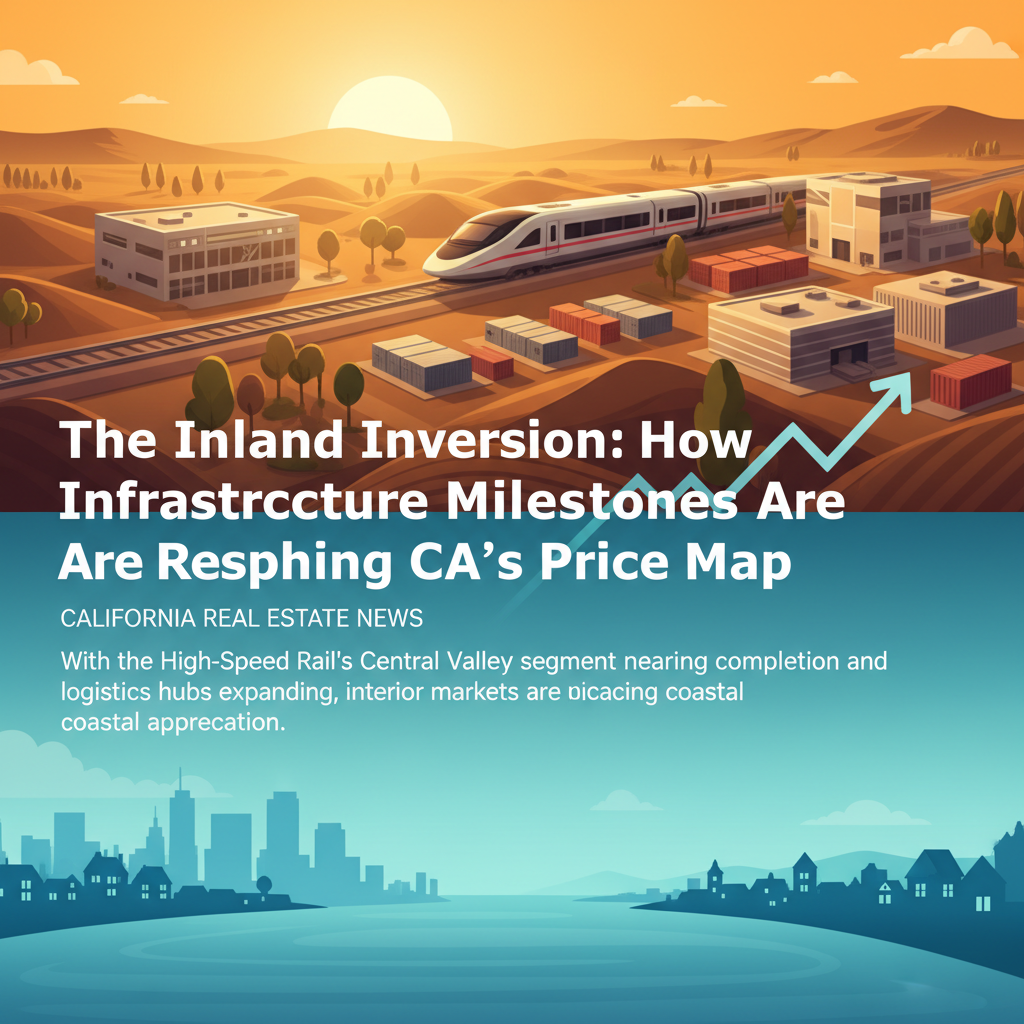
The Shift from Coast to Core: California’s New Growth Engine
For decades, California’s real estate narrative was written almost exclusively on the coast. However, as of April 2026, a significant 'Inland Inversion' has taken hold. While Los Angeles and San Francisco markets have stabilized with a modest 2.1% year-over-year growth, interior markets—specifically the Fresno-Visalia and Merced-Modesto corridors—are reporting price appreciation of 11.4%, according to the latest California Association of Realtors (CAR) quarterly report.
Infrastructure as a Valuation Catalyst
The primary driver for this shift is the tangible progress of the California High-Speed Rail (HSR) Central Valley segment. With track testing now underway and station-area developments in Fresno and Hanford reaching completion, the 'commuter radius' is being fundamentally redefined. Investors are no longer looking at these cities as agricultural hubs, but as viable satellite nodes for a workforce that is increasingly mobile.
Data from the California High-Speed Rail Authority indicates that transit-oriented development (TOD) zones within a half-mile of inland stations have seen a 18% surge in land value over the last 12 months. This mirrors the 'Transit-Rich' premiums seen in coastal cities following AB 2097, but at a significantly lower entry price point.
The Logistics 2.0 Boom
Beyond passenger rail, the expansion of automated logistics hubs in the Inland Empire and Central Valley has created a secondary wealth effect. As major retailers shift to 'Next-Hour' delivery models, the demand for workforce housing in proximity to these 1-million-square-foot facilities has reached an all-time high. In San Bernardino and Riverside counties, vacancy rates for Class B and C multifamily units have dropped to a record low of 2.8%, driving rents up by 9% since April 2025.
Market Data Points (Q1 2026)
- Median Home Price (Central Valley): $485,000 (Up 11.4% YoY)
- Median Home Price (Bay Area): $1,320,000 (Up 1.8% YoY)
- Inventory Levels: Inland markets currently hold a 3.2-month supply, while coastal metros remain constrained at 1.9 months.
- Investment Yields: Cap rates for inland multifamily properties are averaging 6.1%, compared to 4.2% in coastal urban cores.
Practical Takeaways for 2026 Stakeholders
For Investors: Focus on 'Secondary Hub' multifamily opportunities. Cities like Merced and Bakersfield are seeing a rapid influx of professional-class renters who are priced out of coastal markets but require modern amenities. Look for properties within the 'HSR-Radius'—typically a 15-minute commute to future rail stations.
For Sellers: If you own property in the Central Valley or Inland Empire, the current window represents a peak in relative demand. Marketing your property to coastal buyers looking for 1031 Exchange opportunities is a high-probability strategy as they seek to move capital from low-yield coastal assets to high-growth interior ones.
For Buyers: While prices are rising, the entry point remains a fraction of coastal costs. However, with institutional interest shifting toward these growth corridors, the window for 'affordable' entry is narrowing. Financing remains the hurdle; however, local credit unions in the Valley are currently offering 'Infrastructure-Bond' backed mortgages with 0.5% lower rates for first-time buyers in TOD zones.
The Long-Term Outlook
The 'Inland Inversion' is not a temporary bubble but a structural realignment of California’s geography. As the state’s interior becomes more connected through high-speed infrastructure and more economically diverse through the logistics and tech-servicing sectors, the traditional price gap between the coast and the valley will continue to compress. The 2026 market marks the inflection point where the Central Valley stopped being a 'fallback' and started being a 'first-choice' for California capital.