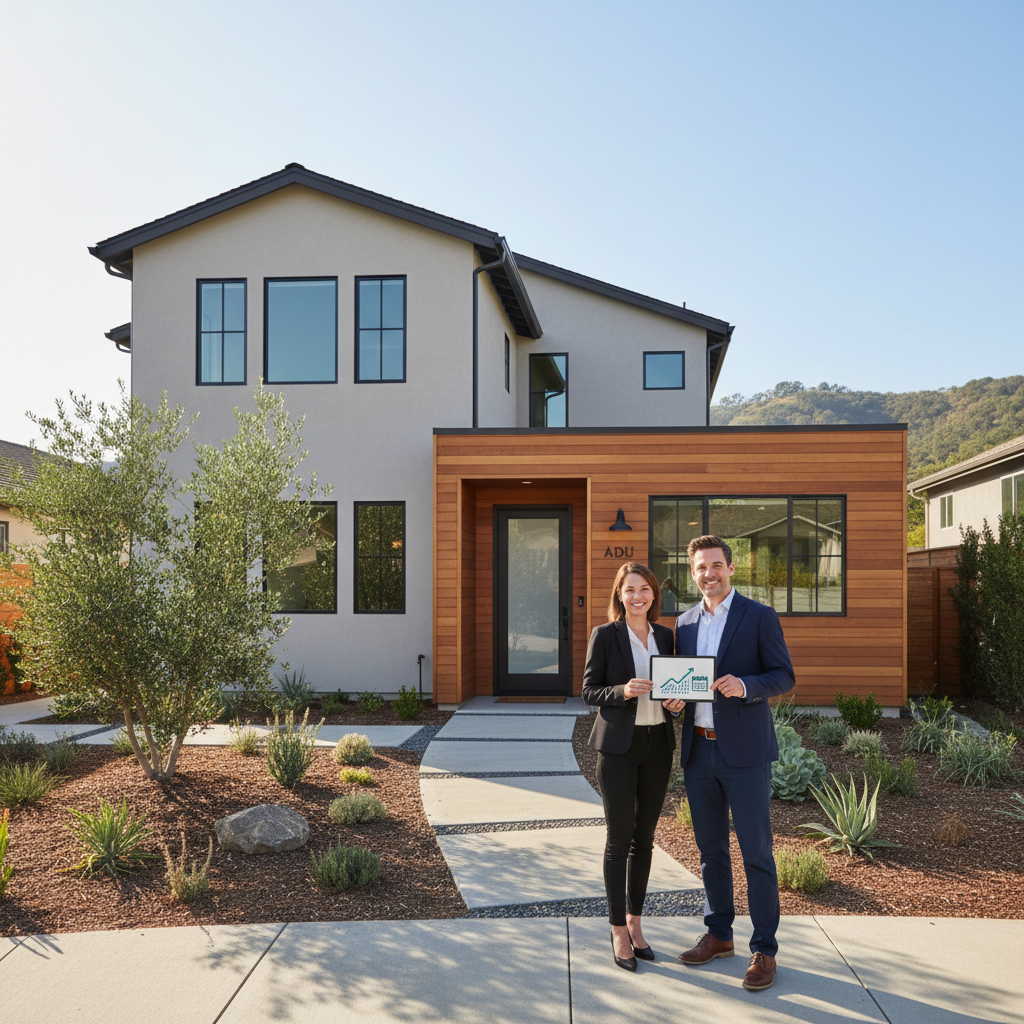
The 6.5% Plateau and the Search for Buying Power
As of late April 2026, the California mortgage market has settled into a 'new normal.' With the 30-year fixed rate stabilizing between 6.4% and 6.7%, the initial shock of the post-inflationary era has worn off, replaced by a calculated search for affordability. In high-cost coastal markets where the median home price remains north of $900,000, traditional debt-to-income (DTI) ratios are being stretched to their limits. However, a significant shift in lending behavior is emerging: the aggressive underwriting of Accessory Dwelling Unit (ADU) income as a primary qualification tool.
The Secondary Suite as a Financial Catalyst
Data from the California Department of Housing and Community Development (HCD) shows that ADU permits now account for nearly 20% of all housing units permitted statewide. While these units were historically viewed as 'granny flats' for extended family, the 2026 lending landscape treats them as vital revenue streams. Unlike previous years where rental income from an ADU could often only be used for a refinance, current Fannie Mae and Freddie Mac guidelines have evolved to allow California buyers to use 75% of *projected* rental income from a permitted ADU to qualify for a purchase mortgage.
The Underwriting Math in 2026
Consider a buyer looking at a $1.2 million property in San Diego or the East Bay. At a 6.5% interest rate, the principal and interest payment alone exceeds $6,000. For a household earning $180,000 annually, the DTI would be prohibitive. However, if the property features a legal junior ADU or a detached cottage with a market rent of $2,400, lenders can often add $1,800 (75% of the projected rent) to the buyer’s qualifying income. This adjustment can lower the effective DTI by as much as 8 to 10 percentage points, turning a 'denied' application into an 'approved' one.
Navigating the 2026 Appraisal Hurdles
The challenge for California buyers in April 2026 is no longer the availability of the programs, but the execution of the appraisal. To utilize this income, the appraiser must provide a Form 1007 (Single-Family Comparable Rent Schedule) specifically for the ADU.
- Comp Selection: In 2026, appraisers are increasingly looking at 'ADU-paired sales' to justify value, rather than just adding a flat square-footage adjustment.
- Permit Verification: Lenders are requiring strict proof of 'Certificate of Occupancy' for the secondary unit to count 100% of the projected income. Unpermitted 'bootleg' conversions remain a non-starter for income qualification.
- The 30% Threshold: Most conventional products limit the total income contributed by the ADU to 30% of the total qualifying income, a safety net designed to prevent over-leverage.
Strategic Takeaways for Today's Buyers
For those navigating the current spring market, the ADU is no longer just a lifestyle amenity; it is a financing bridge. To succeed, buyers should focus on three specific actions:
- Prioritize Permitted Legality: Only search for properties where the ADU is fully permitted for independent living (including a kitchen/kitchenette and separate entrance) to ensure the income is usable for DTI.
- Order the 1007 Early: Ensure your lender requests a rent schedule at the start of the appraisal process to avoid last-minute DTI disqualifications during the contingency period.
- Factor in Management Costs: While the lender uses 75% of the rent for qualification, savvy investors should still model their actual cash flow at an 85% occupancy rate to account for the California tenant-protection environment.
As we move through the second quarter of 2026, the 'house hacking' model has moved from the fringe to the mainstream. In a high-rate environment, the ability to underwrite the future productivity of the land itself is becoming the defining advantage for the California home buyer.


