The Grid-Pricing Divergence
By April 2026, the California real estate landscape has bifurcated. While interest rates have stabilized after the volatility of the mid-2020s, a new operational volatility has emerged: the cost of electrification. With the California Public Utilities Commission (CPUC) overseeing tiered rate increases that have totaled 22% over the last 24 months, the 'carrying cost' of a property is no longer just the mortgage; it is the grid connection itself.
The Data: Energy Resiliency and Valuation
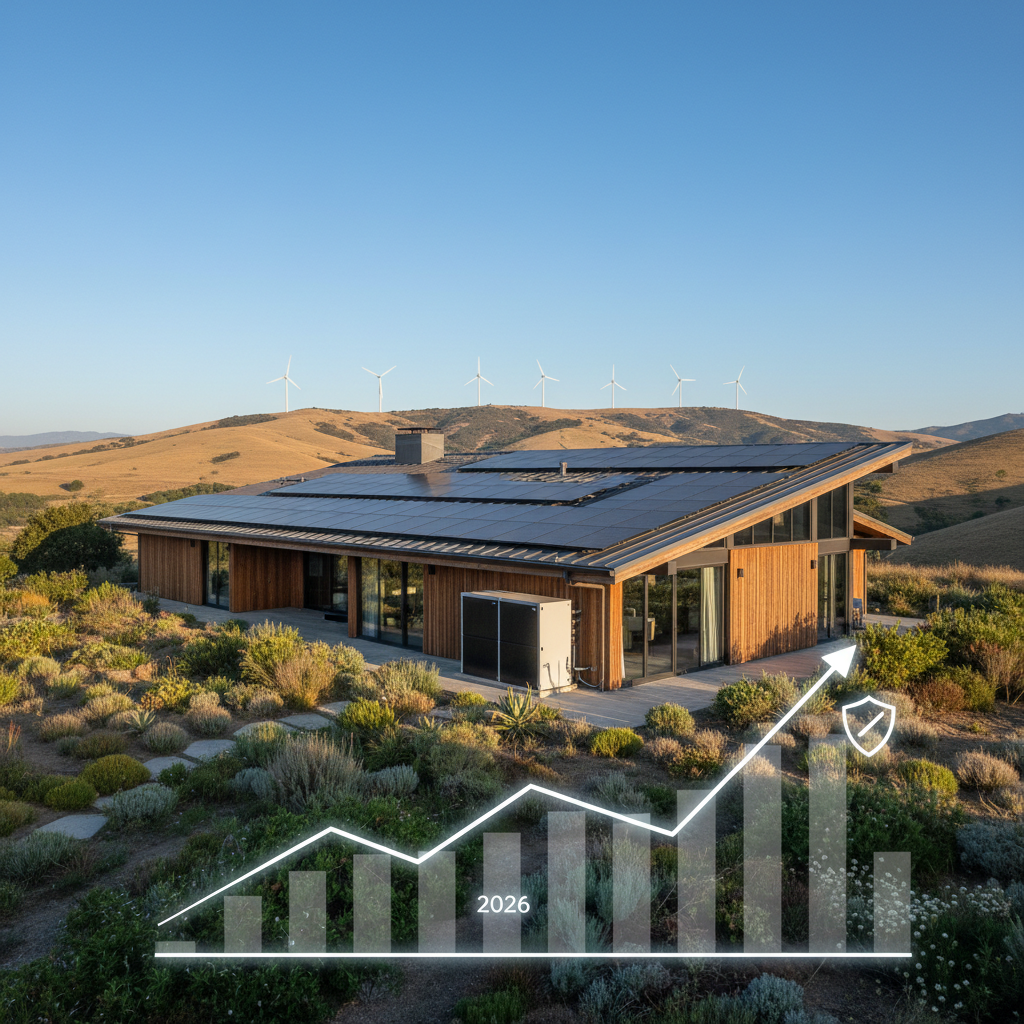
Recent analysis of 2026 MLS data indicates that homes equipped with 'Full-Stack Energy Autonomy'—defined as solar arrays paired with at least 20kWh of battery storage—are selling for a 12.4% premium compared to grid-dependent counterparts in the same ZIP codes. According to CBRE’s Q1 2026 California Outlook, this 'Utility Hedge' is most pronounced in the Inland Empire and Central Valley, where rising cooling costs have shifted from a seasonal nuisance to a primary solvency risk for middle-market residents. Properties that can guarantee a fixed energy cost are seeing significantly lower days-on-market (DOM) than those exposed to utility inflation.
Investment Perspective: From OpEx to Equity
For multi-family investors, the shift is even more dramatic. The capitalization rate (Cap Rate) of a building is now being shielded by the integration of micro-grids. By reducing common-area electricity costs and utilizing Virtual Power Plant (VPP) incentives to sell energy back to the grid during peak demand, owners are seeing Net Operating Income (NOI) increases of 8-15%. Institutional buyers are now discounting non-solar assets by an 'Electrification Penalty,' anticipating the mandatory capital expenditures required to meet 2030 net-zero operational benchmarks.
Practical Takeaways for the 2026 Market
- For Sellers: Audit your 'Energy Score.' Sophisticated buyers are now requesting 24 months of utility history alongside traditional home inspections. Investing in localized storage before listing is yielding a 1.8x ROI in current market conditions.
- For Investors: Target 'Brown-to-Green' conversions. Acquisitions of energy-inefficient mid-century apartment blocks offer the highest value-add potential via communal solar arrays and heat-pump transitions that lower tenant turnover by stabilizing monthly living costs.
- For Buyers: Prioritize V2H (Vehicle-to-Home) compatibility. As EV adoption reaches a critical mass in California this year, the ability to use a vehicle as a backup battery is becoming a top-five search filter on major real estate portals, representing a critical future-proofing feature.