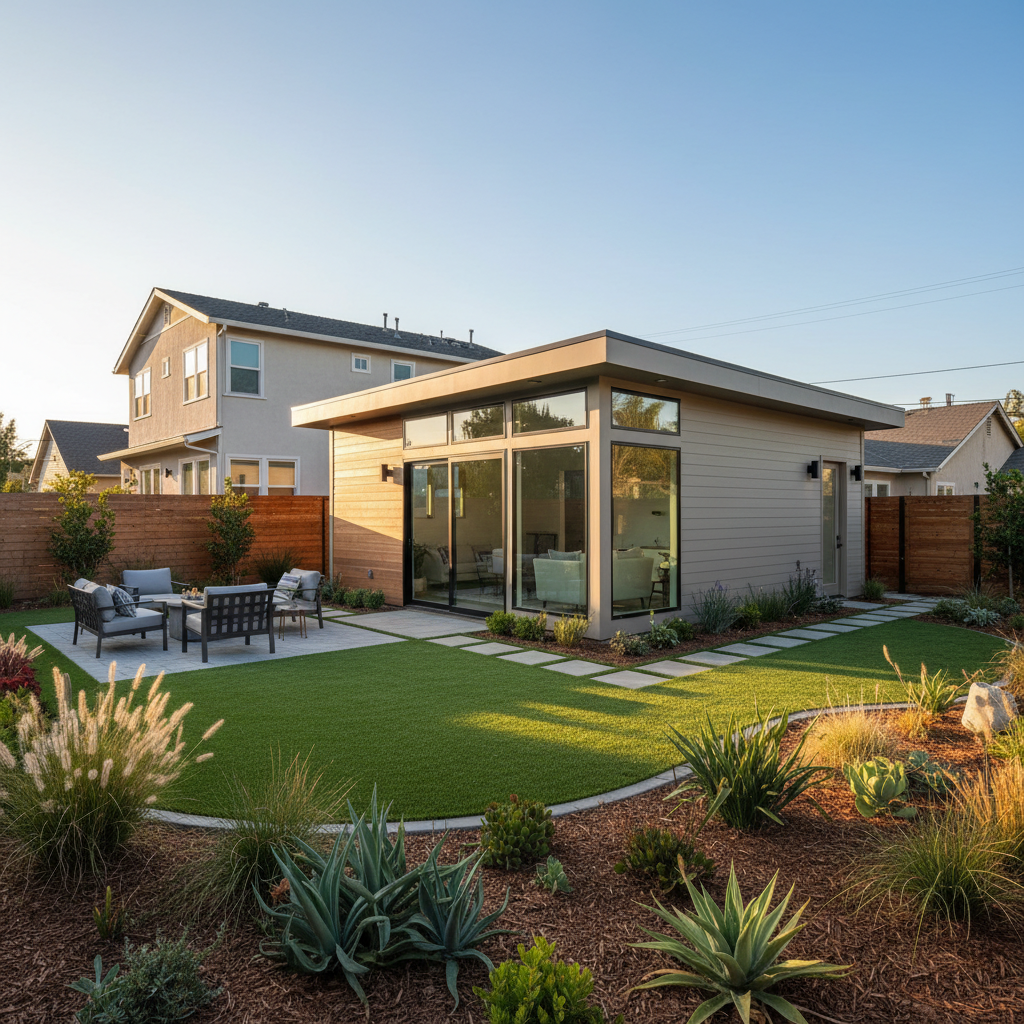
The 2026 Affordability Pivot: From Single-Family to Multi-Revenue
As of April 2026, the California Association of Realtors (C.A.R.) reports the statewide median price for a single-family home has stabilized near $915,000. In coastal hubs like San Diego, Orange County, and the Bay Area, the entry point frequently exceeds $1.2 million. For many buyers, the traditional math of debt-to-income (DTI) ratios no longer works. However, a significant shift in federal and state lending guidelines regarding Accessory Dwelling Units (ADUs) has provided a new path to homeownership.
The Policy Shift: Leveraging Future Rental Income
Following the 2024 FHA policy updates and subsequent Fannie Mae revisions in 2025, buyers in California can now utilize up to 75% of the projected rental income from an ADU to qualify for a mortgage. This applies even if the ADU does not yet exist, provided the loan is an FHA 203(k) renovation loan or a similar conventional construction-to-permanent product.
According to 2025 MLS data, properties with existing ADUs or permitted conversion spaces (like detached garages) command a 12-15% premium but sell 20% faster than their single-use counterparts. The ability to add $2,000 to $3,500 in projected monthly income to a loan application can increase a buyer's purchasing power by as much as $250,000 in the current interest rate environment.
Identifying 'ADU-Ready' Inventory
Not every backyard is a goldmine. To successfully use this strategy in 2026, buyers must look beyond the aesthetic and focus on the 'buildable' footprint. Under California’s mature ADU laws (SB 13 and follow-up legislation), local municipalities are largely prohibited from imposing minimum lot sizes or 'owner-occupancy' requirements through 2026.
- The Setback Standard: Look for properties with at least 4 feet of rear and side-yard clearance.
- Utility Capacity: Older California bungalows often require electrical panel upgrades (200-amp minimum) to support an all-electric ADU, a cost that should be factored into the initial offer.
- The JADU Option: Junior ADUs (converted space within the primary envelope, like a master suite or garage) are the most cost-effective way to generate qualifying income quickly.
The 'Subject To' Appraisal: The 2026 Hurdle
The primary challenge in today’s market is the appraisal. Buyers using projected income must request a 'subject to' appraisal. This document evaluates the home’s value as if the ADU were already completed. Data from the Appraisal Institute suggests that in 2026, California appraisers are now more adept at using 'Income Approach' metrics rather than just 'Sales Comparison' for ADU properties, but buyers must ensure their lender uses a secondary market-certified appraiser familiar with ADU valuations.
Practical Takeaways for the 2026 Buyer
- Get an 'ADU-Specific' Pre-Approval: Do not rely on a standard pre-approval letter. Ask your lender for a DTI workup that includes a 75% rental offset for a potential ADU.
- Audit the Easements: Before removing your inspection contingency, hire a title professional to specifically flag utility easements that could block a backyard build.
- Calculate the 'Real' Cap Rate: While the income helps you qualify for the loan, the math must work for your lifestyle. In 2026, the average cost to build a detached 600 sq. ft. ADU in California is approximately $250,000. At a 7% interest rate, your monthly debt service on that build is roughly $1,660. If the market rent is $2,800, you are netting $1,140 toward your primary mortgage.
Conclusion
The California buyer in 2026 is no longer just a resident; they are a micro-developer. By leveraging federal lending shifts and California’s permissive zoning, buyers can bypass the affordability ceiling. Success in this market requires identifying properties not for what they are today, but for the rental revenue they are legally entitled to produce tomorrow.


