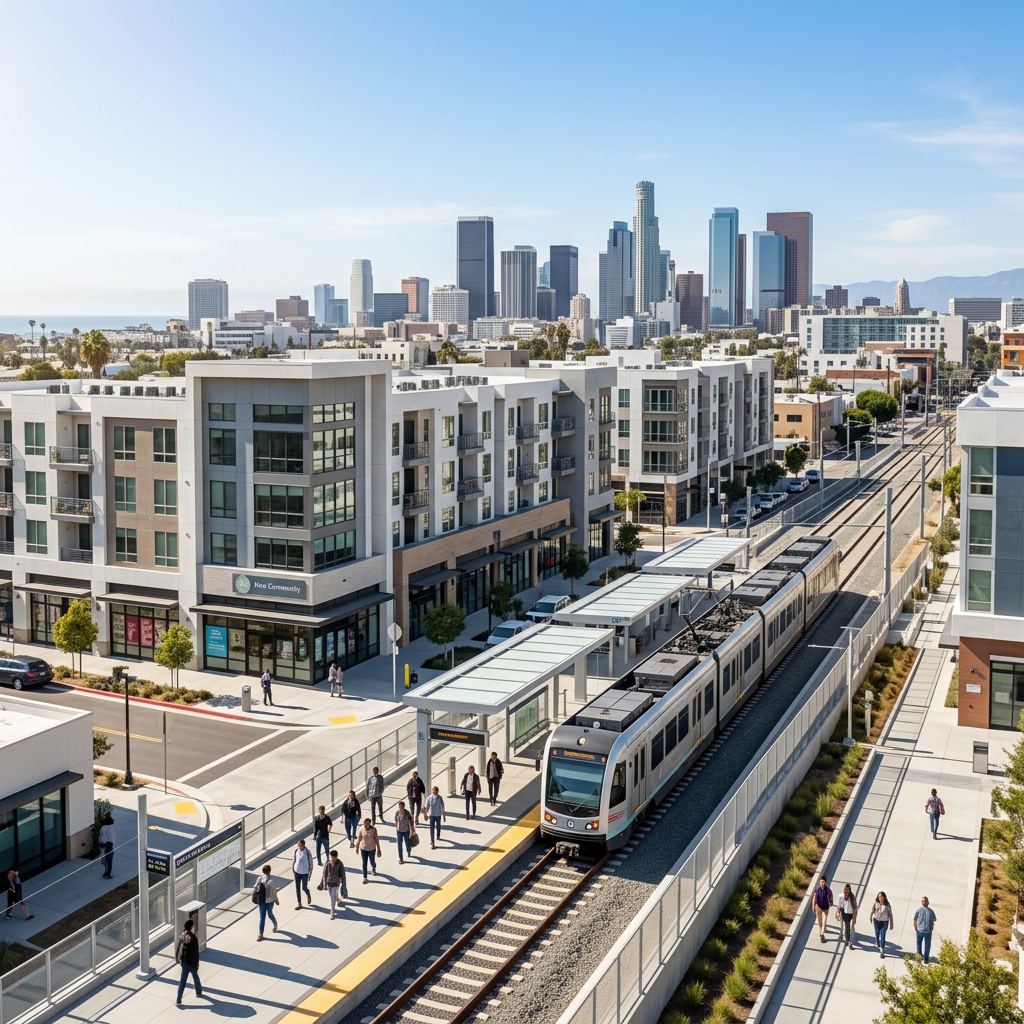
The Era of the Zero-Parking Parcel
As of April 14, 2026, the California real estate landscape is witnessing a profound divergence in urban land valuations. Three years after the full implementation of AB 2097—the landmark legislation that prohibited local governments from imposing minimum parking requirements on developments within a half-mile of major transit—the market is finally seeing the delivery of the first wave of 'parking-free' residential hubs. The result is a widening price-per-square-foot gap between transit-adjacent parcels and traditional car-centric lots.
Data-Driven Valuation Shifts
According to the Q1 2026 California Association of Realtors (CAR) Infill Report, land parcels qualified under AB 2097 are now commanding a 22% premium over comparable lots located outside of transit buffers. This 'Transit-Rich Premium' is driven by the stark reality of construction economics. In major hubs like Los Angeles, San Diego, and San Jose, the cost of constructing a single subterranean parking stall has ballooned to $85,000, factoring in 2026 labor rates and material costs.
By eliminating these mandates, developers are reporting a 15% to 18% reduction in total project costs. More importantly, they are maximizing 'yield-per-acre' by converting what would have been ramp space and parking stalls into additional dwelling units or communal amenities. Data from CBRE’s 2026 Development Outlook suggests that zero-parking projects are achieving 12% higher Net Operating Income (NOI) compared to traditional developments, primarily due to lower debt service on construction loans and higher density.
The Urban Consumer Evolution
The market movement isn't just supply-side. Consumer sentiment has shifted as 'Generation Alpha' begins to enter the rental market and older Gen Z buyers prioritize walkability over garage space. 'We are seeing a permanent decoupling of the 'home' and the 'car' in the California mindset,' says Marcus Thorne, a senior urban analyst. 'In 2026, a studio apartment in San Francisco with a walk score of 98 but zero parking is moving 15 days faster on the MLS than a similar unit with a deeded spot three miles from the BART station.'
Practical Takeaways for Investors and Sellers
- For Land Sellers: If your property is within 0.5 miles of a 'major transit stop' (as defined by Public Resources Code Section 21064.3), your land value is likely significantly higher than standard comps suggest. Ensure your marketing materials explicitly highlight AB 2097 eligibility and the potential for 'zero-parking' density.
- For Residential Buyers: Be prepared for 'parking-unbundled' listings. In 2026, more California condos are selling parking spaces as separate deeded assets. Buying a unit without parking can save you an average of $70,000 on the purchase price, but consider the long-term resale liquidity if the neighborhood's transit infrastructure isn't fully matured.
- For Infill Developers: Focus on 'Micro-Mobility Integration.' Projects that replace parking garages with high-end bike valets, e-scooter charging hubs, and dedicated ride-share loading zones are seeing the highest appraisal uplifts.
Regulatory Horizon
While AB 2097 has unlocked significant value, the California Department of Housing and Community Development (HCD) is already monitoring 'parking spillover' in adjacent neighborhoods. Investors should be aware that while developers are exempt from mandates, some municipalities are countering with increased residential parking permit (RPP) fees for residents of zero-parking buildings. However, for the 2026 market, the momentum is clear: the most valuable land in California is no longer defined by how many cars it can hold, but by how many people it can house within walking distance of a train.


