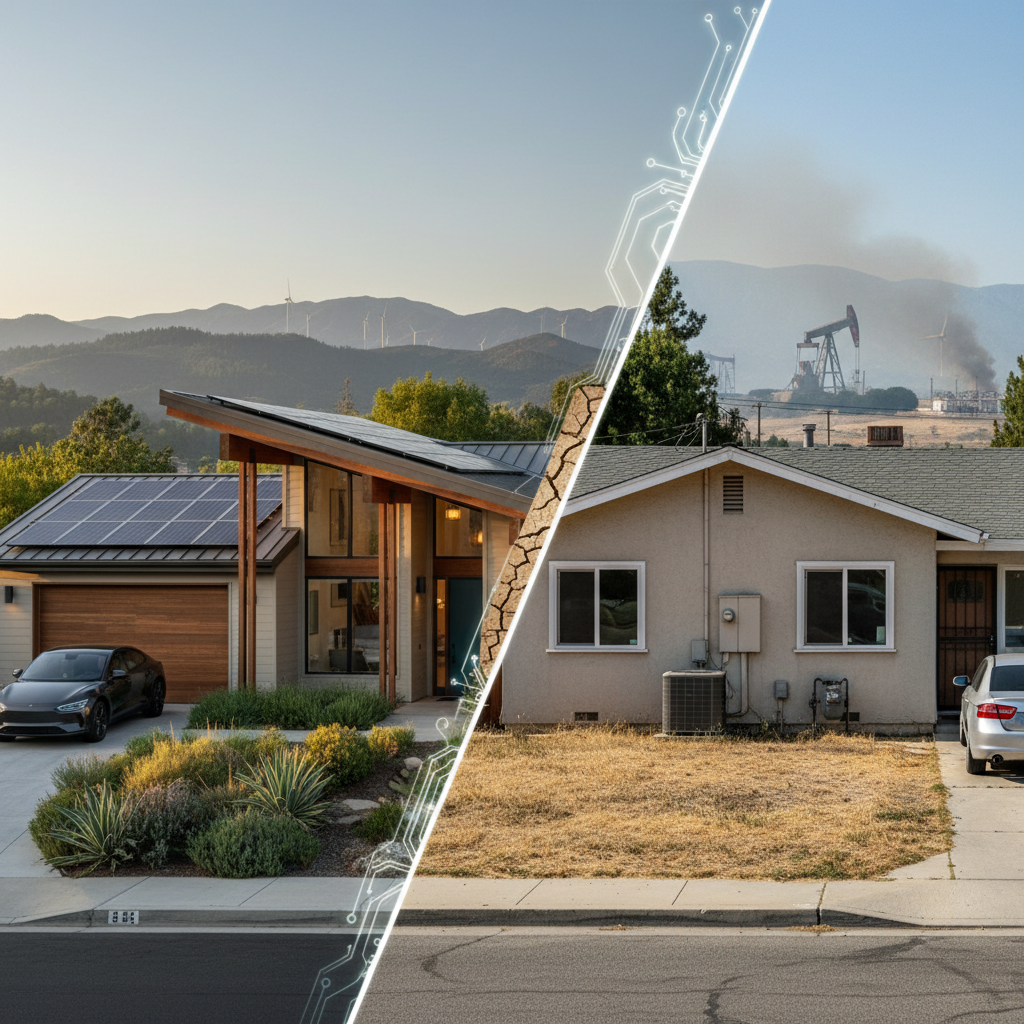
The Emergence of the 'Green Tier' in California Real Estate
As of April 2026, the California real estate market is witnessing a fundamental shift in how value is appraised. While location and square footage remain primary drivers, a third pillar has solidified: energy efficiency and carbon neutrality. Following the full implementation of the California Energy Commission’s (CEC) latest building standards, we are seeing the emergence of a 'Decarbonization Premium' that is bifurcating the market into future-proofed assets and legacy liabilities.
Data-Driven Valuation: The Efficiency Gap
Recent MLS data from the first quarter of 2026 indicates that homes equipped with whole-home electrification, heat pump technology, and Level 2 EV charging infrastructure are commanding a 7.4% price premium over comparable non-retrofitted homes in the same ZIP codes. This is a significant jump from the 3.2% premium observed in 2024. According to the California Association of Realtors (CAR), 'green-certified' listings in the Los Angeles and Bay Area metros are also spending 12 fewer days on the market than their fossil-fuel counterparts.
This trend is driven by more than just environmental altruism. With utility rates from major providers like PG&E and SCE rising by nearly 15% year-over-year, the operational cost of a home has become a critical component of debt-to-income (DTI) calculations for savvy buyers. In 2026, a high-efficiency home isn't just a lifestyle choice; it is a hedge against energy inflation.
Investment Perspectives: Avoiding the 'Stranded Asset'
From an investment standpoint, the risk of 'stranded assets'—properties that require prohibitively expensive retrofits to meet future municipal codes—is no longer a theoretical concern. Several California municipalities, including San Francisco and San Jose, have moved forward with 'point-of-sale' electrification requirements. Investors who failed to anticipate these costs are finding their margins compressed during the disposition phase.
Conversely, institutional buyers and REITs have pivoted toward 'Deep Green' retrofitting. By leveraging federal tax credits under the matured Inflation Reduction Act (IRA) and California’s own rebate programs, investors are capturing value by purchasing older 1970s-era housing stock and performing full electrification flips. The ROI on these improvements is currently averaging 145%, as buyers prioritize homes that are exempt from the increasing 'carbon-impact' fees being discussed in Sacramento.
Practical Takeaways for 2026 Stakeholders
For those navigating the current California landscape, the following strategies are recommended:
- For Sellers: Prioritize electrification over cosmetic upgrades. A documented 12-month history of low energy bills is currently a more potent marketing tool than a kitchen backsplash. Ensure your agent highlights 'HERS' (Home Energy Rating System) scores in the listing.
- For Buyers: Look beyond the purchase price. A lower-priced legacy home may carry a 'shadow mortgage' in the form of high utility costs and pending retrofit mandates. Factor a $25,000 to $40,000 electrification budget into any offer on a gas-reliant property.
- For Investors: Focus on the 'Middle-Market Green' niche. There is a supply shortage of suburban single-family homes that meet 2026 efficiency standards. Targeting B-class neighborhoods for energy-centric renovations offers a clearer path to equity growth than traditional luxury flips.
Economic Outlook: The Regulatory Horizon
Looking toward the second half of 2026, we expect the decarbonization premium to stabilize as it becomes the industry standard. However, the window for capturing the 'early adopter' alpha is closing. As appraisal models increasingly integrate HERS scores and solar-plus-storage capacity into their final valuations, the distinction between a 'standard' home and a 'green' home will vanish—leaving those who failed to adapt with diminished liquidity in an increasingly sophisticated market.