The Great Silicon Valley Conversion
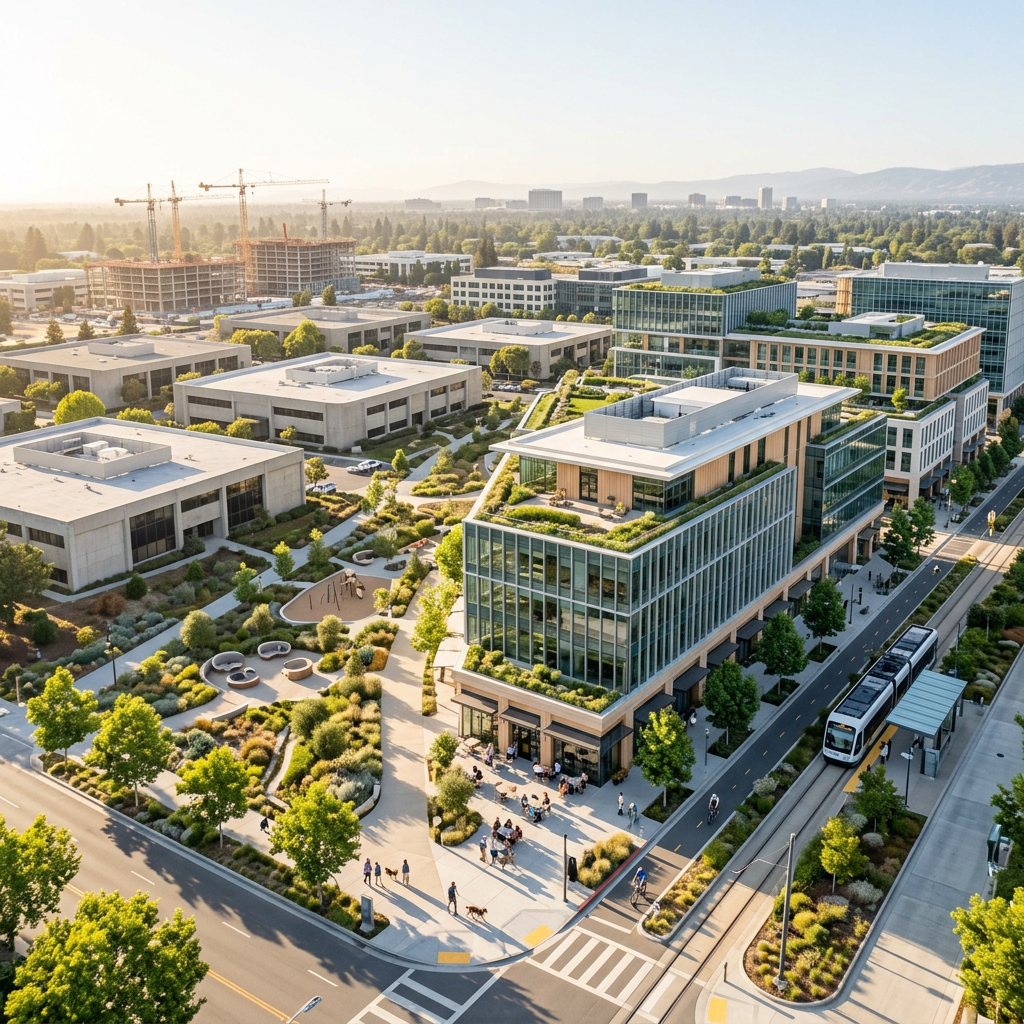
For decades, Sunnyvale’s Moffett Park was defined by sprawling parking lots and low-slung R&D buildings. However, as of April 2026, it has emerged as the most significant case study in 'Social-Tech Urbanism' in California. Following the 2023 approval of the Moffett Park Specific Plan, the 1,200-acre district is mid-way through a transformation that is adding 20,000 new residential units to a submarket once strictly reserved for the 9-to-5 grind.
Data-Backed Growth: The Density Mandate
The shift is driven by necessity and state-mandated housing targets (RHNA). According to recent 2025-2026 MLS data for Santa Clara County, inventory in traditional single-family neighborhoods remains tight, but Moffett Park has become the primary release valve for new supply. CBRE reports indicate that while traditional office vacancies in the Bay Area hovered near 25% in 2025, 'integrated-use' zones like Moffett Park are seeing 15% higher lease premiums due to their proximity to high-density housing and transit.
Key Community Features and Amenities
- The 15-Minute Neighborhood: The master plan prioritizes walkable 'activity nodes' that eliminate the need for car commutes. Residents now have access to over 500,000 square feet of new retail and service space centered around 11th-generation LEED-certified buildings.
- Ecological Resilience: Unlike the concrete jungles of the past, 2026’s Moffett Park features enhanced channel corridors designed for sea-level rise protection and urban heat island mitigation, providing over 30 acres of new public parkland.
- Educational Integration: The Sunnyvale School District has partnered with developers to integrate 'satellite campuses' within mixed-use buildings, catering to the growing demographic of tech-sector families who prefer urban living over suburban sprawl.
Transportation and Connectivity
Moffett Park is the flagship for the VTA’s (Santa Clara Valley Transportation Authority) updated light rail strategy. With the completion of the 'Orange Line' optimization project in late 2025, transit frequency has increased by 30%. The district is also a pilot site for autonomous micro-shuttles that connect the residential towers to the nearby Google Caribbean campus and Lockheed Martin facilities, reducing local Vehicle Miles Traveled (VMT) by an estimated 18% compared to 2022 levels.
Practical Takeaways for Real Estate Stakeholders
For Investors
Capitalize on the 'First-Mover' advantage. While initial cap rates are compressed due to high construction costs, the long-term appreciation is anchored by corporate giants like Google and Meta, who continue to anchor the district's commercial core. The 'Social-Tech' model ensures lower tenant turnover compared to isolated apartment complexes.
For Buyers
Focus on units with 'Flexible Work' designations. In 2026, the most resilient asset values are found in properties with dedicated home-office infrastructure and high-speed fiber-optic integration, which are standard in the Moffett Park new-builds.
For Sellers
Owners of older light-industrial or commercial properties in the vicinity should look into 'Assembly Potential.' As the district expands, land-use conversions are commanding significant premiums from institutional developers looking to scale residential footprints.
The Bottom Line
Moffett Park represents the death of the isolated office park and the birth of a holistic urban ecosystem. By prioritizing density and transit over parking and sprawl, Sunnyvale has created a 2026 blueprint for how Silicon Valley can maintain its economic dominance while finally addressing its chronic housing shortage.