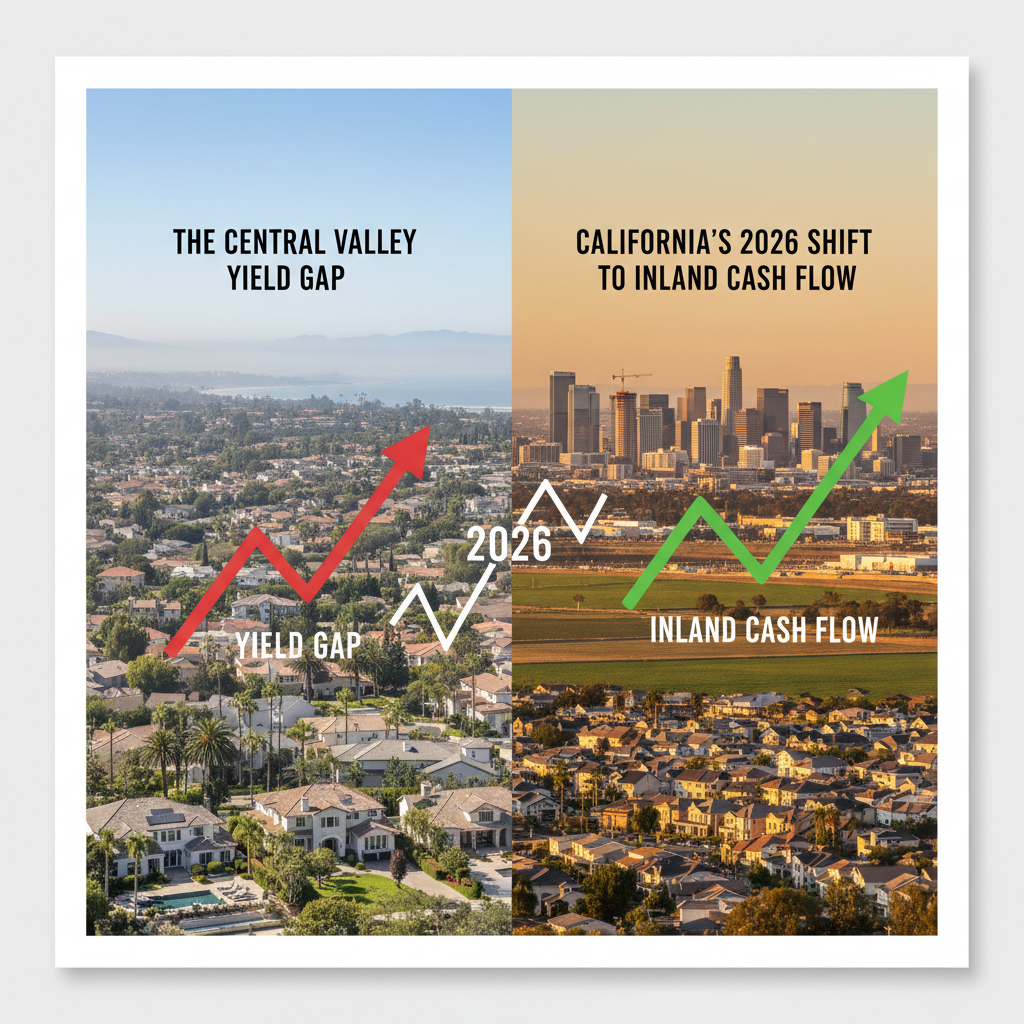
While the coastal metropolises of Los Angeles and the Bay Area continue to grapple with a high-equity, low-velocity environment, a distinct divergence is appearing in California’s interior. As of March 2026, the 'Central Valley Yield Gap' has become the focal point for institutional and private investors seeking the cash flow that has all but evaporated from the Pacific coastline.
The Migration Catalyst: Data-Driven Demand
According to recent California Department of Finance population projections for 2026, inland counties such as Fresno, San Joaquin, and Kern are outperforming the state average in net migration. While coastal populations have stabilized, the Central Valley is absorbing the 'overflow' of remote and hybrid workers who have been priced out of the coastal 'Transit Corridors.' This demographic shift is not merely anecdotal; U.S. Census Bureau pulse data indicates a 4.2% year-over-year increase in household formation within the Fresno-Madera MSA, significantly outpacing the 1.1% seen in the San Francisco-Oakland-Hayward corridor.
Cap Rate Disparity: Coastal vs. Inland
The primary driver for the 2026 inland pivot is the stark contrast in yields. CBRE’s Q1 2026 Cap Rate Survey highlights that stabilized multi-family assets in San Jose are averaging a compressed 3.8%, barely covering debt service at current interest levels. In contrast, the Stockton and Bakersfield markets are seeing cap rates hovering between 6.1% and 6.5%. For the first time in a decade, the risk-adjusted return on inland residential assets is significantly higher than coastal equivalents, even when accounting for the traditionally lower appreciation rates of the interior.
Infrastructure and Logistics: The Economic Backbone
The economic resilience of the Central Valley in 2026 is underpinned by two major factors: the maturation of the California High-Speed Rail (HSR) construction phase and the continued dominance of the logistics sector. With the HSR’s Central Valley segment nearing operational readiness for 2028 testing, speculative investment in 'station-adjacent' multi-family housing has surged. Furthermore, the logistics sector remains a powerhouse; NAR data shows industrial vacancy rates in the Inland Empire and Central Valley remain below 4%, driving secondary demand for workforce housing.
Practical Takeaways for 2026 Investors
- Target 2-4 Unit Multi-Family: Smaller multi-family units in cities like Modesto and Visalia are currently offering the best balance of financing ease and cash-on-cash return.
- Utilize 1031 Exchanges: Coastal owners with high equity but stagnant cash flow are increasingly using 1031 exchanges to trade one coastal SFR for a diversified portfolio of inland duplexes.
- Monitor the 'Commuter Limit': Focus on sub-markets within 30 minutes of emerging tech satellites in Sacramento or logistics hubs in Tracy to capture the highest-quality tenant pool.
As we move into the second quarter of 2026, the California real estate narrative is no longer about statewide appreciation, but about the strategic capture of inland yield. The 'Locked-In' effect of the coast has created a vacuum that the Central Valley is perfectly positioned to fill, offering a sanctuary for capital that requires immediate performance over long-term speculative growth.