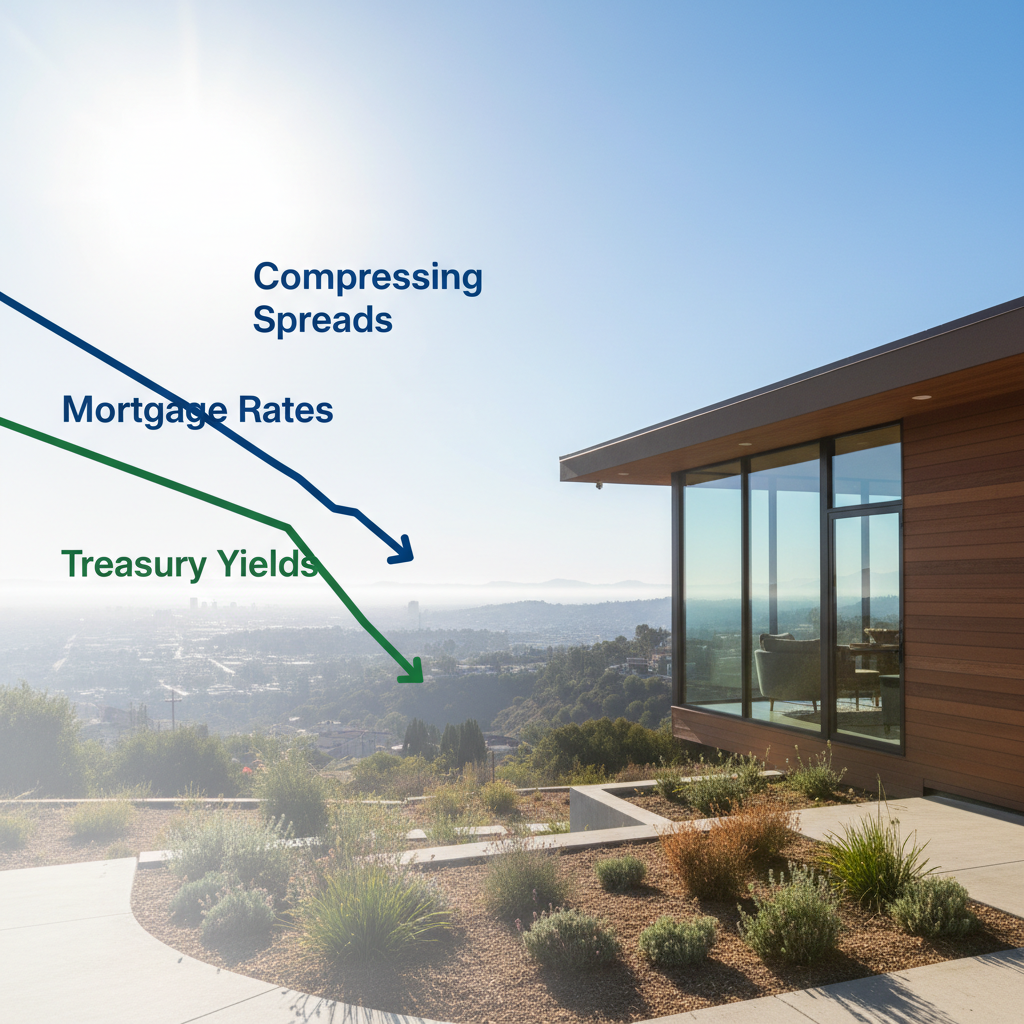
The Invisible Force Lowering California Borrowing Costs
As of March 27, 2026, the California real estate market has reached a state of equilibrium that few predicted two years ago. While much of the headlines focus on the Federal Reserve’s federal funds rate, a more significant shift is occurring in the 'spread'—the difference between the 10-year Treasury yield and the 30-year fixed mortgage rate. For the first time in the post-pandemic era, this spread is returning to its historical average, creating a 'volatility discount' for Golden State home buyers.
Understanding the 2026 Spread Compression
Historically, the spread between the 10-year Treasury and a 30-year mortgage has hovered around 170 to 200 basis points. In the height of the 2023-2024 inflation surge, this gap widened to over 300 basis points as lenders priced in extreme risk and market volatility. Today, with the 10-year Treasury sitting near 4.1%, we are seeing mortgage rates finally settle into the 5.8% to 6.0% range. This compression represents a significant normalization in the secondary mortgage market.
According to data from the National Association of Realtors (NAR) and recent Freddie Mac surveys, the tightening of this spread is a direct result of decreased interest rate volatility. When lenders are less fearful of sudden rate spikes, they require less of a 'risk premium,' allowing them to pass savings directly to the consumer without a corresponding drop in Treasury yields.
The Impact on California’s High-Balance Markets
In high-cost regions like San Francisco, Orange County, and San Diego, even a 40-basis-point narrowing of the spread has an outsized impact. On a typical California conforming high-balance loan of $1,149,825 (the 2026 limit in many counties), the difference between a 6.4% rate and a 5.9% rate is approximately $375 per month. Over a five-year period, this equates to over $22,000 in interest savings.
- Increased Purchasing Power: Buyers who were sidelined in 2025 are finding that their debt-to-income (DTI) ratios are now clearing the hurdle for mid-tier suburban properties.
- Reduced MBS Volatility: Mortgage-Backed Securities (MBS) are seeing increased demand from institutional investors, further stabilizing the floor for California lenders.
- Secondary Market Confidence: Lenders are no longer 'padding' rates in anticipation of Fed surprises, leading to more transparent pricing during the pre-approval process.
Strategic Takeaways for March 2026 Buyers
With the spread compressing, the strategy for buyers and investors has shifted from 'waiting for a crash' to 'capitalizing on stability.' Here is how to navigate the current lending environment:
1. Prioritize 'Par' Pricing
In a low-volatility environment, paying high discount points to buy down a rate is often less effective than it was in 2024. With spreads narrowing naturally, ask your lender for 'par' pricing—the rate available without additional fees—to see if the organic market movement meets your budget needs.
2. Lock-In Strategy: 45 Days is the New 15
While volatility is lower, the California market remains sensitive to monthly jobs reports. Investors and buyers should consider 45-day locks to navigate the minor fluctuations that occur as the spread continues its slow descent toward the 170-basis-point historical norm.
3. Leverage 'Relationship Spreads'
Many California-based regional banks are currently aggressive in their efforts to regain market share. These institutions are sometimes willing to shave an additional 15–25 basis points off the market spread for clients who move their primary banking or investment portfolios to the institution, a move known as 'relationship pricing.'
The Bottom Line
The story of March 2026 isn't about the Fed cutting rates—it’s about the market finding its footing. The narrowing spread is a signal of a maturing, stable economy. For California buyers, this means that while the era of 3% rates remains a memory, the era of 'volatility-inflated' rates is officially over.


