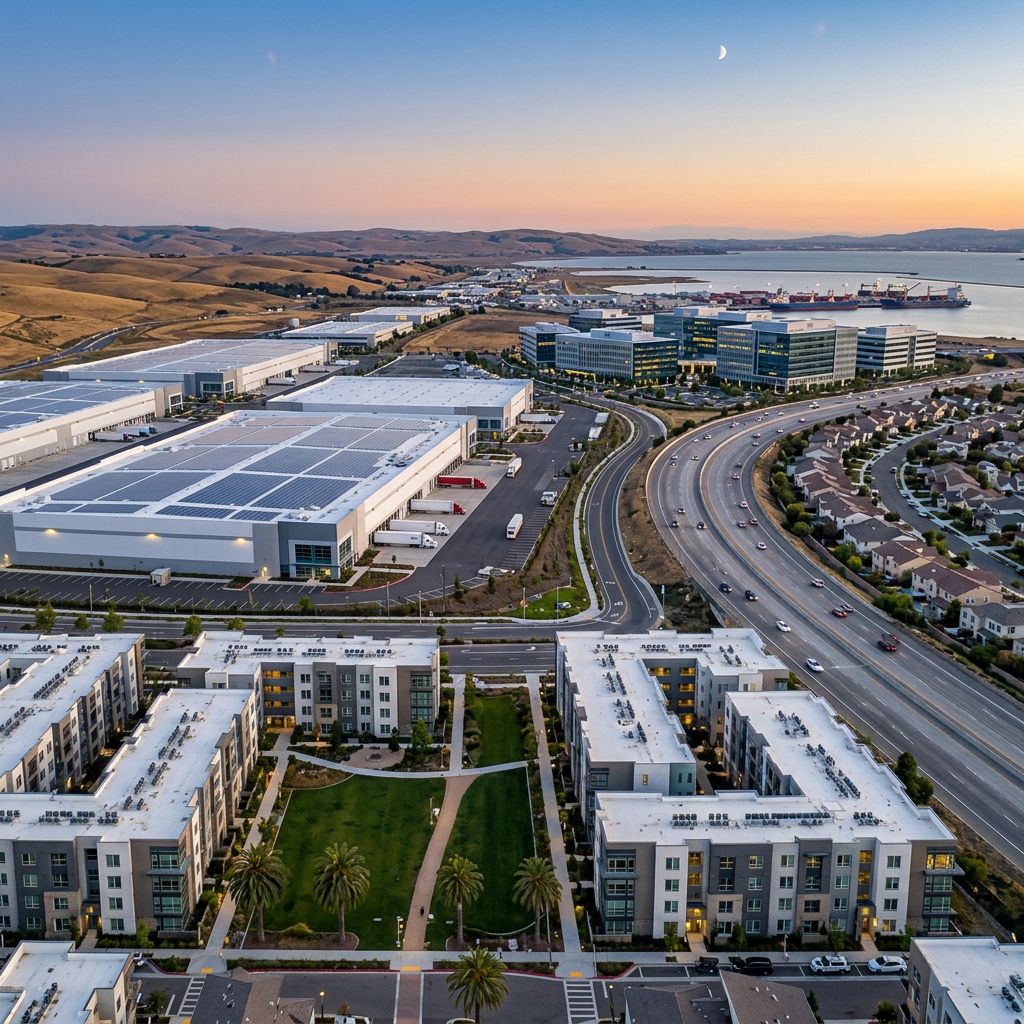
The Shift from Warehousing to Production
In the first quarter of 2026, California’s industrial real estate sector is undergoing its most significant evolution in a decade. While the 2020-2024 period was defined by the e-commerce warehousing boom, the current market is being reshaped by the domestic 're-shoring' of advanced manufacturing. According to 2026 CBRE Industrial Outlook reports, the demand for specialized facilities—equipped with high-load power and advanced water cooling—has surged by 18% year-over-year in the Inland Empire and the San Joaquin Valley.
The Economic Multiplier Effect
This industrial pivot is not occurring in a vacuum. Data from the California Employment Development Department (EDD) indicates that high-tech manufacturing jobs in these regions carry a 2.7x multiplier effect on local economies. Unlike the transient nature of logistics labor, these high-skill roles are anchoring a new class of homebuyers in traditionally affordable inland markets. Consequently, residential real estate in 'manufacturing-adjacent' zip codes is seeing a 6.4% premium over broader county averages, defying the stagnation seen in purely commuter-based suburbs.
Investment Perspectives: The Rise of Flex-Industrial
For institutional and private investors, the opportunity has shifted toward 'Flex-Industrial' spaces. These properties, which combine R&D office space with light manufacturing and distribution, are currently maintaining a 3.8% vacancy rate, significantly lower than the 12% average for traditional suburban office parks. The 2026 market is rewarding versatility. Investors are increasingly retrofitting older, high-ceiling warehouses to meet the specific requirements of EV battery assembly and biotech hardware production.
Practical Takeaways for the 2026 Market
- For Investors: Target 'Power-Ready' properties. In 2026, the bottleneck for industrial growth is energy grid capacity. Sites with existing high-voltage infrastructure are commanding 15-20% rent premiums over standard shells.
- For Residential Buyers: Focus on 'Secondary Industrial Hubs' like Stockton, Riverside, and Tracy. These areas are transitioning from warehouse towns to manufacturing centers, promising better long-term equity growth than over-saturated coastal markets.
- For Sellers: Highlight proximity to high-growth employment centers. Marketing a home's accessibility to new tech-industrial corridors is now more effective than highlighting proximity to major metro downtowns.
Looking Ahead: The Inland Renaissance
As California continues to navigate a high-interest environment, the synergy between industrial growth and residential demand remains the most reliable driver of ROI. The 2026 'Industrial-Residential Nexus' proves that while the coastal high-rise market remains cautious, the heart of California’s economic future is being built on the production floor.