The 2026 California Housing Market: Navigating the Supply-Demand Paradox
As we enter the spring home-buying season of 2026, the California real estate landscape continues to defy traditional cyclical expectations. Despite a three-year period of fluctuating interest rates, the state’s median home price has remained remarkably resilient, recently crossing the $865,000 threshold according to the latest data from the California Association of Realtors (CAR). This resilience is not merely a product of demand, but a structural scarcity of inventory that has fundamentally altered the investment playbook for the Golden State.
Market Analysis: The Coastal Floor and Inland Expansion
Current MLS data reveals a stark bifurcation between California’s coastal hubs and its inland corridors. In markets like San Francisco and San Diego, inventory levels remain at historic lows—approximately 2.1 months of supply—keeping prices elevated even as volume stays modest. Conversely, the Inland Empire and the Central Valley have seen a 12% year-over-year increase in transaction volume. Investors are increasingly looking to cities like Riverside and Fresno, where the price-to-rent ratio offers more attractive cash-flow opportunities compared to the equity-heavy coastal regions.
Investment Perspective: The Rise of Density-Driven Assets
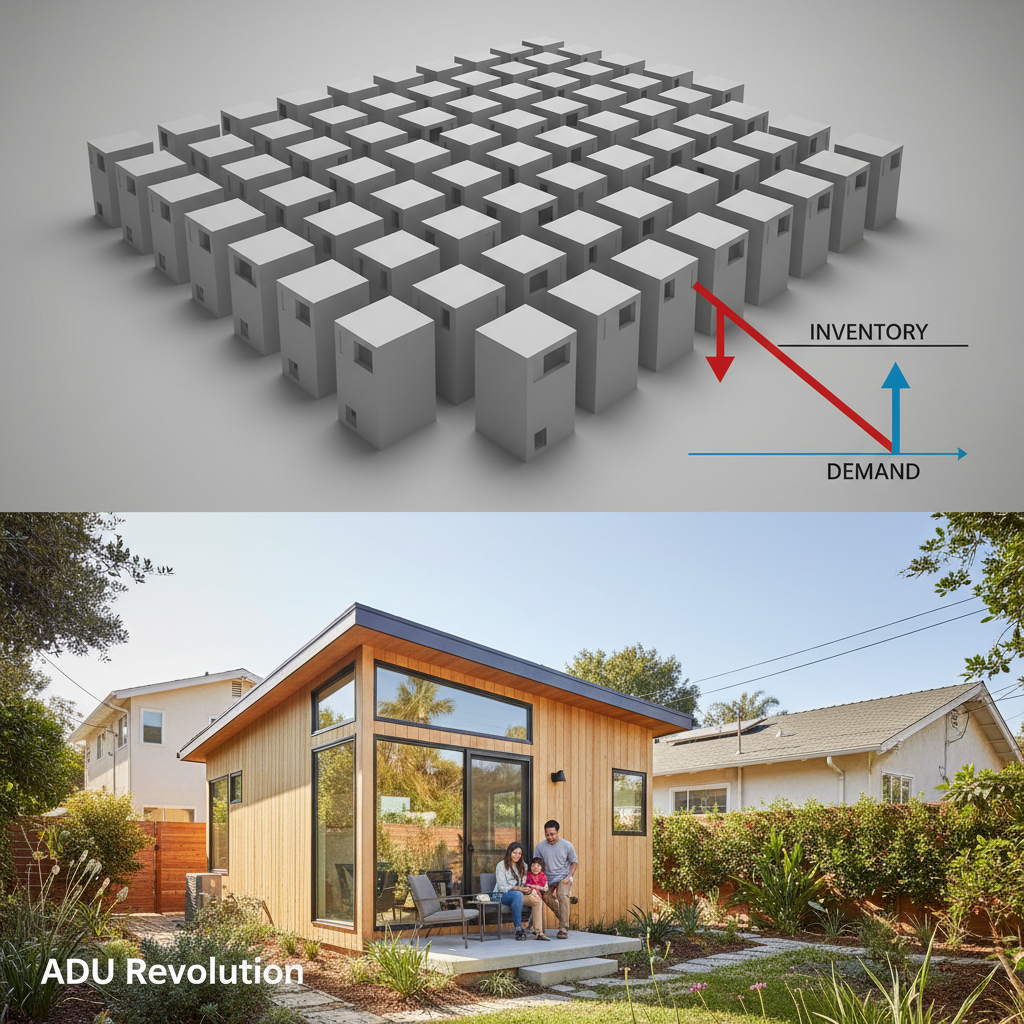
The most significant shift in 2026 is the mainstreaming of 'density-driven' investing. Recent legislative tailwinds, including the refinement of SB 9 and SB 10, have made it significantly easier for homeowners and investors to capitalize on single-family lots. CBRE reports that nearly 15% of all new residential permits in California now include Accessory Dwelling Units (ADUs). For the modern investor, the strategy has shifted from simple 'fix-and-flip' to 'develop-and-hold,' utilizing ADUs to offset high mortgage costs and maximize per-square-foot yield.
Economic Trends: Hybrid Work and Net Migration Realities
While much was made of the 'California Exodus' in years past, Census Bureau data from late 2025 indicates a stabilization in net migration. The state’s economy, bolstered by a resurgent tech sector and green energy initiatives, continues to attract high-earning professionals. However, the hybrid work equilibrium has permanently shifted demand toward properties that offer 'zoom rooms' and proximity to transit hubs rather than immediate city centers. This has created a 'second-ring' suburb boom, where properties 30 to 50 miles outside of major employment cores are seeing the highest rate of appreciation.
Practical Takeaways for 2026
- For Buyers: Focus on 'buy-and-build' opportunities. Purchasing a property with a large lot and ADU potential is currently the most effective way to build immediate equity in a supply-constrained market.
- For Sellers: Transparency is the new currency. With 2026 buyers being more data-savvy, providing pre-inspections and energy-efficiency certifications can reduce time-on-market by an average of 18 days.
- For Investors: Look to the Central Valley. As infrastructure projects like the High-Speed Rail move closer to partial completion, transit-oriented development in previously overlooked areas is poised for a 5-year growth cycle.
Ultimately, the 2026 California market rewards those who view real estate through the lens of utility and density rather than speculative appreciation. The path to profitability now runs through creative land use and a deep understanding of local zoning evolutions.